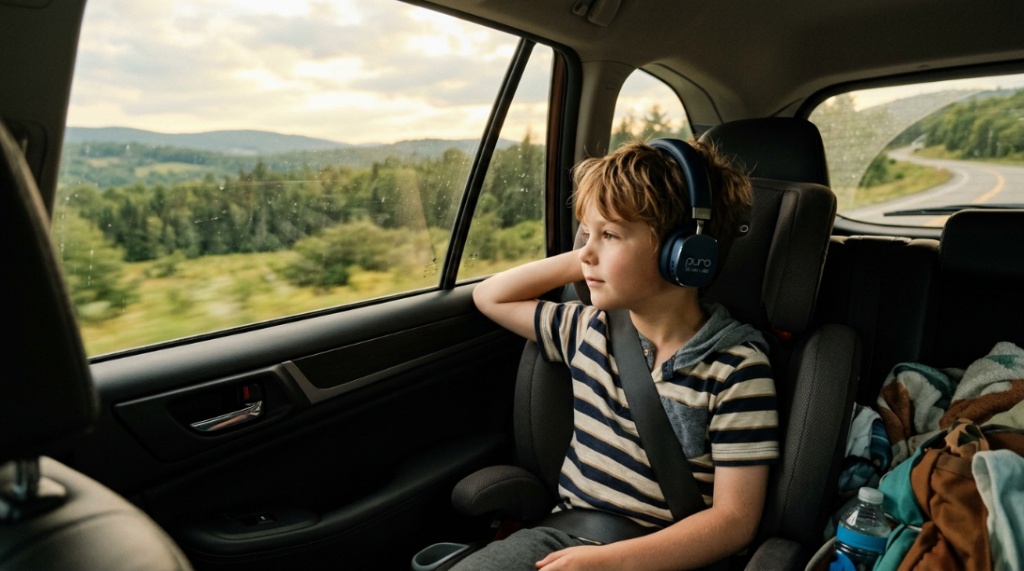
One in eight children between ages 6 and 19 already shows measurable noise-induced hearing damage—and headphones are the primary exposure source, delivering sound directly into ear canals at volumes that quietly destroy irreplaceable cochlear cells while parents assume the content is the concern rather than the delivery volume. Protecting your child’s hearing requires safe headphones for children with built-in volume limiters that physically prevent output from exceeding 85 dB—the threshold above which cumulative exposure duration begins causing permanent, irreversible hearing loss. Volume-limited headphones for kids are specifically engineered with hardware circuits or firmware locks that cap maximum sound output at safe levels (typically 85dB), ensuring children cannot accidentally or intentionally raise volume into hearing-damage territory regardless of source device settings or content loudness. The invisible danger? Hearing loss from headphone use is gradual, painless, and undetectable until significant damage has already accumulated. A child listening at 95 dB for one hour daily accumulates hearing damage equivalent to working in a factory without ear protection—yet experiences no pain, no immediate symptoms, and no awareness that permanent loss is occurring. Volume-limited headphones for kids eliminate this invisible risk through engineering that parents can trust when supervision isn’t constant.
How Does Volume Damage Children’s Hearing Differently Than Adults’?
Children’s hearing is more vulnerable because their shorter ear canals amplify sound by 7–9 dB more than adult canals, their developing cochlear structures are more susceptible to mechanical stress damage, and their lifetime exposure clock starts decades earlier—meaning damage accumulates across a longer remaining lifespan.
Key vulnerability factors:
- Ear canal amplification: A child’s ear canal is shorter and narrower than an adult’s—creating acoustic resonance that amplifies incoming sound by 7–9 dB. Headphones producing an 85 dB measured output deliver approximately 92–94 dB at a child’s eardrum. This means children need a lower measured volume to receive equivalent sound pressure—making adult volume limits inadequate for children’s ears.
- Cochlear vulnerability: The stereocilia (hair cells) in children’s developing cochleae are more sensitive to metabolic exhaustion from sustained loud sound than mature adult structures. The same exposure duration and volume creates proportionally more cellular damage in children than adults.
- Cumulative lifespan exposure: A child who begins headphone use at age 6 has 60+ years of potential exposure ahead. Even subclinical damage (not yet detectable on hearing tests) accumulates year over year—meaning today’s “safe” exposure at slightly-above-threshold levels creates measurable deficits by adulthood that could have been entirely prevented.
- Behavioral risk amplification: Children lack the judgment to self-regulate volume, the awareness to recognize danger signs (ringing, muffled hearing after use), and the impulse control to maintain volume discipline when “turning it up” makes their show more exciting. External hardware limits substitute for absent self-regulation capacity.
WHO data context: the World Health Organization estimates that over 1 billion young people (ages 12–35) are at risk of hearing loss due to recreational noise exposure—with personal audio devices being the single largest contributing factor. Volume-limited children’s headphones address this epidemic at its starting point: the moment children begin headphone use.
What Volume Limit Actually Protects Children’s Hearing?
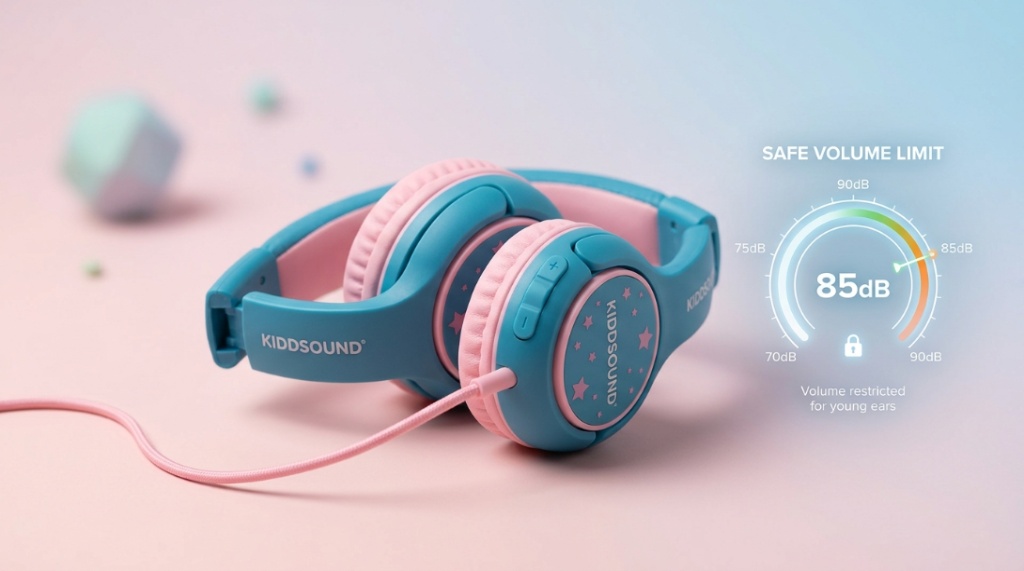
85 dB is the internationally recognized maximum safe listening level for children—allowing up to 2 hours of daily exposure without measurable hearing damage, as established by the World Health Organization, American Academy of Pediatrics, and international hearing safety standards.
Volume safety thresholds explained:
| Volume Level | Safe Continuous Duration | Risk Level for Daily Use | Common Reference |
|---|---|---|---|
| 70 dB or below | Unlimited | Zero risk | Normal conversation at 3 feet |
| 75 dB | Unlimited (effectively safe) | Near-zero risk | Quiet office, background music |
| 85 dB | 2 hours maximum | Safe within time limit | Recommended max for kids’ headphones |
| 90 dB | 30 minutes | Moderate risk with regular exposure | Busy restaurant, hair dryer |
| 95 dB | 15 minutes | High risk | Many headphones at 60–70% volume |
| 100 dB | 5 minutes | Very high risk | Many headphones at 80% volume |
| 105+ dB | Under 1 minute | Immediate damage threshold | Headphones at maximum volume (some models) |
Critical insight: standard adult headphones without volume limiting commonly reach 100–115dB at maximum volume. A child turning volume to “full” on unrestricted headphones can receive sound levels that cause measurable damage within 5–15 minutes. Volume-limited headphones capping at 85 dB make this scenario physically impossible—regardless of what the child does with the controls.
What Types of Volume-Limiting Technology Exist?
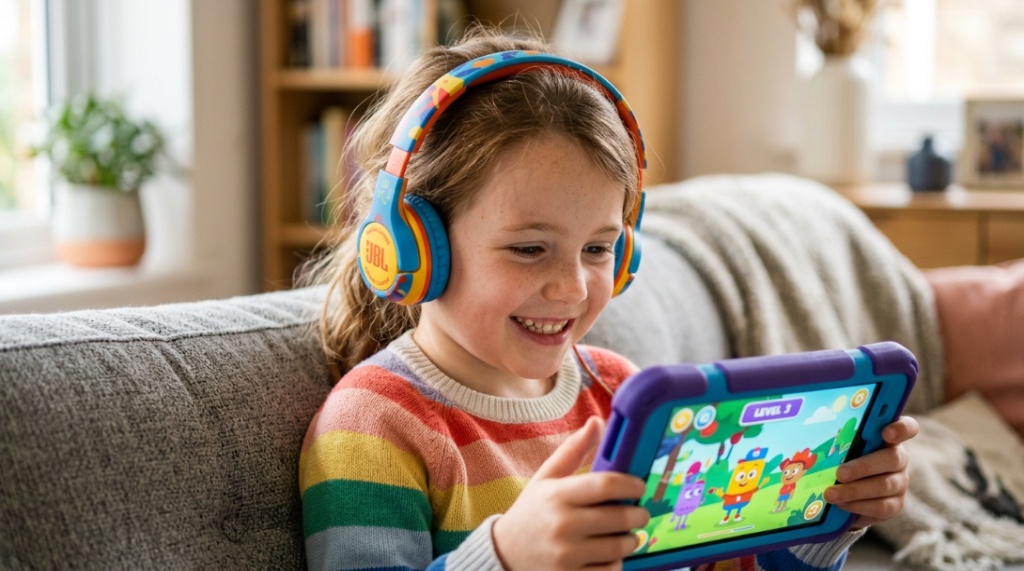
Three types of volume-limiting technology protect children: hardware circuit limiters (most reliable, cannot be bypassed), firmware digital limiters (reliable if not resettable), and cable-based inline limiters (add-on devices that limit any existing headphone’s output).
Technology comparison:
- Hardware circuit limiter (gold standard): A physical resistor or circuit built into the headphone that electrically limits maximum speaker output. Cannot be bypassed by any software, device setting, or user action. The speaker physically cannot produce sound above the threshold. Found in: Puro Sound Labs, JBL JR series, BuddyPhones (hardware mode).
- Firmware digital limiter (very reliable): Volume ceiling programmed into the headphone’s onboard processor. Cannot be changed without manufacturer tools or firmware reflashing (beyond children’s capability). Allows features like adjustable parent-set limits while maintaining an absolute ceiling. Found in: BuddyPhones Cosmos+ (switchable modes), some Beats models.
- App-based parental limit (moderately reliable): Parents set a volume ceiling through a companion app. Reliable while configured properly. Risk: factory reset removes the limit; tech-savvy older children may discover bypass methods. Requires parent to verify limit remains active periodically. Found in: some Sony, JBL, and generic brand models.
- Inline cable limiter (add-on option): A small adapter that plugs between any headphone and audio source, electrically limiting signal before it reaches the headphone driver. Allows using any headphone at safe volume. Limitation: only works in wired mode; doesn’t limit Bluetooth connections. Products: Puro IEM volume limiter, BuddyPhones SafeAudio adapter.
Recommendation hierarchy: hardware circuit limiter for children under 10 (cannot be bypassed under any circumstance). Firmware digital limiter for children 10–13 (reliable with minimal bypass risk). App-based for responsible teenagers who understand the reasoning but benefit from a safety net.
How Do You Verify a Volume Limiter Actually Works?
Verify volume limiting by testing at maximum volume with a smartphone sound level meter app (should read 82–87 dB at ear distance), comparing loudness against a known-limited reference headphone, and checking for third-party testing verification from the manufacturer or independent reviewers.
Verification methods:
- Sound level meter app test: Download a free decibel meter app (NIOSH Sound Level Meter for iOS or Sound Meter for Android). Play music at maximum headphone volume, holding the phone microphone at the ear cup opening (approximately where your child’s ear would be). Reading should show 82–87 dB for an 85 dB-limited headphone. Above 90 dB indicates the limiter isn’t functioning as claimed.
- Comparative loudness test: If you own a verified volume-limited headphone (Puro, JBL JR), compare maximum loudness side-by-side. The new headphones should sound approximately equally loud or quieter at maximum. If the new pair is noticeably louder at max, the limit may be absent or set higher than claimed.
- Manufacturer verification: Quality brands (Puro Sound Labs) publish independent audiological testing certificates. Check the brand’s website for third-party lab verification of their stated dB limits. Brands that only claim “volume limited” without providing verification data may not meet their own stated specification.
- Real-world listening test: At 85 dB (arm’s length from headphones while playing), you should be able to hear content clearly but not feel any discomfort or ringing after 30 minutes of listening. If maximum volume creates any ear discomfort, ringing, or the “stuffed” feeling after use, the actual output likely exceeds 85 dB.
Which Volume-Limited Headphones Offer the Best Protection?
The best-verified volume-limited headphones for children are Puro BT2200 Plus (independently audiologist-tested 85 dB, ANC included), JBL JR460NC (verified 85 dB hardware limit, 30-hour battery), and BuddyPhones Cosmos+ (switchable 75/85/94 dB, SafeAudio certified).
- Puro BT2200 Plus ($80–$100): The only children’s headphone brand founded specifically by parents concerned about hearing loss and designed with direct audiologist input. The 85 dB limit is independently verified through third-party laboratory testing. Studio-grade drivers deliver quality audio within safe limits. ANC reduces the need to raise volume in noisy environments. Gold standard for verified hearing protection.
- JBL JR460NC ($50–$70): JBL’s engineering credibility backs their 85dB limit claim. A 30-hour battery ensures the headphones never die mid-use (pushing children toward unsafe alternatives). ANC protects against volume escalation in noise. Excellent value for verified safety from a major audio brand.
- BuddyPhones Cosmos+ ($60–$80): SafeAudio technology with switchable levels — parents choose 75dB (toddler), 85dB (standard), or 94dB (supervised teen). This flexibility serves families with children of different ages using the same headphones. ANC included. 152g ultralight for young children’s comfort.
- LilGadgets Connect+ Pro ($35–$50): Hardware-limited at 93dB (slightly above ideal but safer than unlimited). Budget-accessible. SharePort for siblings. BPA-free materials. Good entry option for families wanting basic protection at minimal cost—though 85 dB models provide better protection for the price difference.
Beyond Headphones: What Else Protects Children’s Hearing?
Complete hearing protection extends beyond headphones to include limiting daily headphone duration (regardless of volume level), teaching children to recognize warning signs, scheduling regular hearing checks, and reducing environmental noise exposure from other sources in their daily life.
- Time management (60/60 rule): Listen at no more than 60% volume for no more than 60 minutes before taking a 10-minute break. Even at 85dB (safe), auditory fatigue benefits from rest periods. Teach children this as a habit rather than relying solely on the volume limiter to provide complete protection.
- Warning sign education: Teach children to recognize and report ringing/buzzing in ears after headphone use, muffled hearing that takes minutes to clear, and needing to raise volume higher than usual to hear content clearly (indicates existing damage reducing sensitivity). Any of these signs warrant hearing evaluation.
- Annual hearing checks: Include audiometric testing in annual checkups — particularly for children who use headphones daily. Early detection of high-frequency hearing loss (the first area affected) enables intervention before damage progresses to conversational frequency ranges.
- Environmental noise awareness: Headphones aren’t the only source. Concerts, sporting events, fireworks, power tools, and even prolonged school cafeteria exposure (80–85 dB for 30+ minutes) contribute to cumulative load. Ear protection at loud events complements volume-limited headphone use for comprehensive hearing preservation.
- Model healthy behavior: Children mimic parent habits. If parents listen at high volumes with visible headphones, children interpret this as safe/normal behavior. Demonstrate moderate listening yourself and verbalize why: “I keep my volume here because I want to hear well when I’m older.”
While over-ear models are generally recommended for younger kids because they sit comfortably over the ear canal, older children and teens often prefer a more compact fit. If you are looking for alternatives that offer excellent sound control and portability for older kids, check out our roundup of the three best in-ear headphones you can buy today to find a pair that balances safety with performance.
Conclusion
Protecting your child’s hearing with volume-limited headphones is one of the simplest, most impactful health investments a parent can make—eliminating an invisible daily risk that causes permanent, irreversible damage without any pain or warning signs until significant hearing loss has already occurred. Hardware-capped 85dB headphones make dangerous volume physically impossible while delivering clear, enjoyable audio that children don’t perceive as restrictive once their ears adjust to appropriate levels.
Choose headphones with verified (not merely claimed) volume limiting from brands with demonstrated commitment to children’s auditory health. Pair volume-limited headphones with ANC to prevent the noise-escalation behavior that drives children toward dangerous volumes. Add time management habits and regular hearing checks for comprehensive protection. And remember: the hearing your child has today is the maximum they’ll ever have—every decibel of preventable damage avoided in childhood compounds across their entire remaining lifetime of hearing ability.
Frequently Asked Questions
At what age should kids start using volume-limited headphones?
From the first moment they use any headphone—typically age 2–4 when parents introduce audio content via headphones for the first time. There is no age where volume limiting is unnecessary. Even teenagers benefit from limits that prevent impulsive volume-raising during exciting content. The earlier volume-limited listening becomes habitual, the more natural and appropriate volume levels feel throughout childhood.
Will my child complain that volume-limited headphones are too quiet?
Initially, children accustomed to unrestricted volume may perceive 85 dB as “too quiet”—this perception reflects prior unsafe exposure, not inadequate volume. Within 1–2 weeks of consistent use at 85 dB, auditory perception recalibrates, and the limited volume sounds completely natural and clearly audible. The adjustment period is brief; the hearing protection is permanent.
Can volume-limited headphones still damage hearing?
At 85dB, hearing damage requires more than 2 hours of continuous daily exposure. If your child uses volume-limited headphones for under 2 hours daily (following WHO/AAP guidelines), hearing damage risk is negligible. The combination of volume limit + time limit provides comprehensive protection. Only extended daily use exceeding 2–3 hours at 85 dB would begin approaching concern—and even then, damage occurs far more slowly than at unrestricted volumes.
Should I choose a 75 dB or 85 dB volume limit for my child?
75 dB for children under 5 or those with sensory sensitivity provides maximum protection with zero hearing risk at any duration. 85 dB for children 5–13 who need content clearly audible in moderately noisy environments—allows comfortable listening in real-world conditions while maintaining a safe threshold. Both are safe; 75 dB is more conservative, and 85 dB is more practical for everyday contexts where some ambient noise exists.
Do volume-limited headphones sound worse than regular headphones?
No—volume limiting affects loudness, not audio quality. A well-designed 85dB-limited headphone (Puro, JBL JR) produces clear, full-range, detailed audio—simply at a safe maximum loudness. Cheap volume-limited headphones may sound bad due to poor driver quality (unrelated to the volume limit). Choose brands known for audio quality (JBL, Puro) to get both safety AND good sound simultaneously.
How do I know if my child has already experienced hearing damage?
Early signs include frequently asking “what?” in conversation, turning TV/content volume higher than previously, difficulty following conversations in noisy environments (restaurants, classrooms), complaints of ringing or buzzing after headphone use, and academic performance decline (difficulty hearing instructions clearly). Any of these warrant professional audiometric evaluation. Early detection enables intervention and prevents further progression—but cannot restore already-damaged cells.